Why we built it

We kept hearing the same conversation from companies across different industries.

"We're starting to see AI agents arrive as customers. They don't have email addresses. They don't sign up. They don't carry the kind of credentials we issue to humans. What do we do?"

The honest answer is that the existing model wasn't built for them. API keys assumed a human filling out a form. Agents don't sign up. They arrive with wallets — the same wallets they use to pay for things, prove conditions, and interact with other software.

We sell managed products that handle wallet authentication end-to-end. SkyeGate gates content. SkyeWoo handles commerce. AgentTalk runs multi-party agent sessions. But not every company wants a managed product. Some want a primitive — something they can drop into their own stack, on their own terms, without buying anything.

That option didn't exist as a clean, neutral, free package. So we built one.

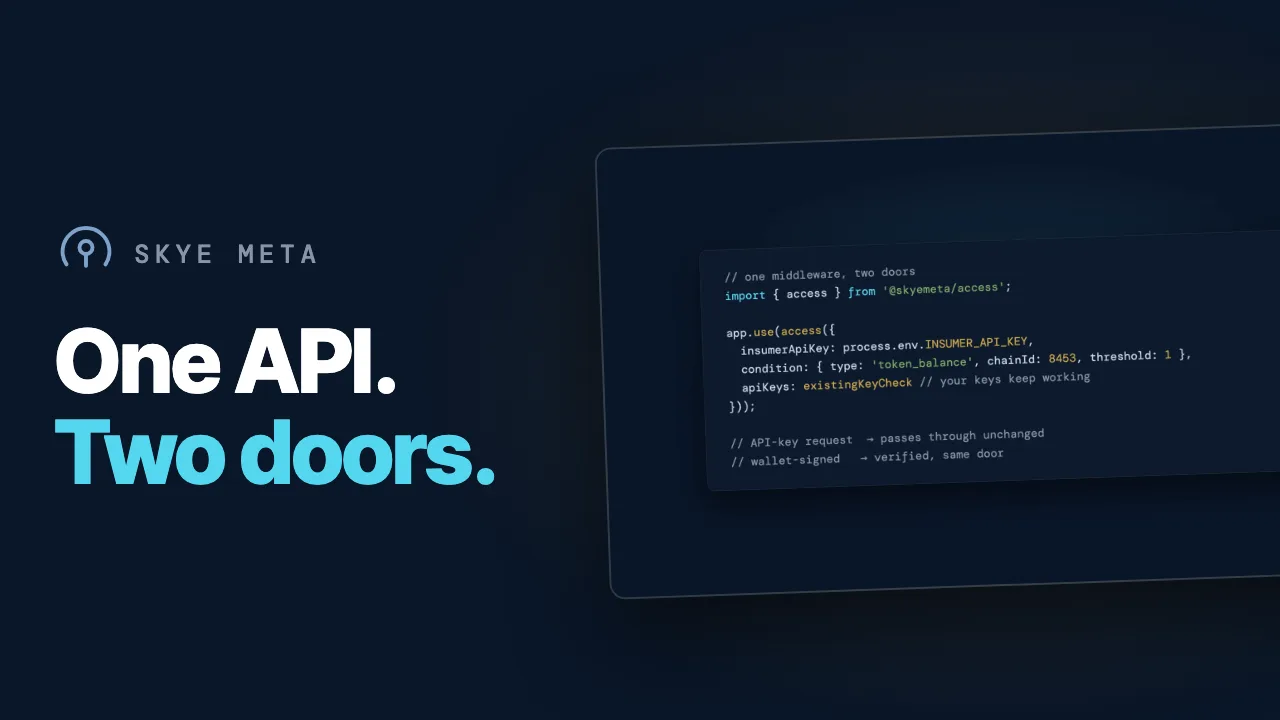
@skyemeta/access is the result. It's MIT-licensed and lives on npm. Anyone can install it, fork it, ship it. We open-sourced it because wallet authentication shouldn't be locked behind any single vendor — including us. The more services that accept wallet signatures, the more agents have a place to go. The more places agents can authenticate this way, the more wallet-native machine authentication becomes practical.

Why it's right for companies with agent customers

If your API is starting to serve AI agents, this is what changes when you use it:

Where to find specifics

This page is the why. For everything else — install steps, code examples, configuration options, the full feature surface — see:

Want a managed product instead?

If you'd rather we run wallet authentication for you than install a package, look at the paid side of the house:

Different products, same primitive underneath.

Pick the layer that matches what you're trying to ship.